

Look up, every now and then
What a cardinal, Hirayama, and the art of noticing taught me about living

Sitting outside, phone in hand, searching for a way to get house sparrows away from a bird feeder that I recently put in my yard.
In other words, I’m a beginner at bird watching.
I didn’t know that house sparrows are a non-native invasive species in North America — brought over from Europe in the 1850s. Moreover, their aggressive behavior drives out native birds from their habitats and takes over bird feeders like colonizers, including mine.
I became determined to attract more native birds, especially a Northern Cardinal.
But cardinals won’t come if the bird feeder is overrun by house sparrows. So I switched the food from a cheap mix of seed blend to pure safflower seeds in hopes of evicting the greedy house sparrows. House sparrows dislike safflower because the shell is too hard to break open and it tastes bitter. On the other hand, cardinals love safflower.
A few days go by and house sparrows were still nipping away at the bird feeder, little by little, albeit not nearly as much as the other seeds. Still no cardinals. Still no other birds. Frustrated, I sat down on my steps, pulled out my phone, and googled what I should do next. Hopefully someone on Reddit has the same problem as me.
Maybe I need a different seed. Maybe it’s the bird feeder. Maybe I just need to give it more time.
Before I could finish reading the small text on my darkened screen, a flash of red appears across my peripheral vision.
I looked up.
A Northern Cardinal with a crimson body and a black face mask perched atop the weathered steel-grey fence beside the bird feeder.
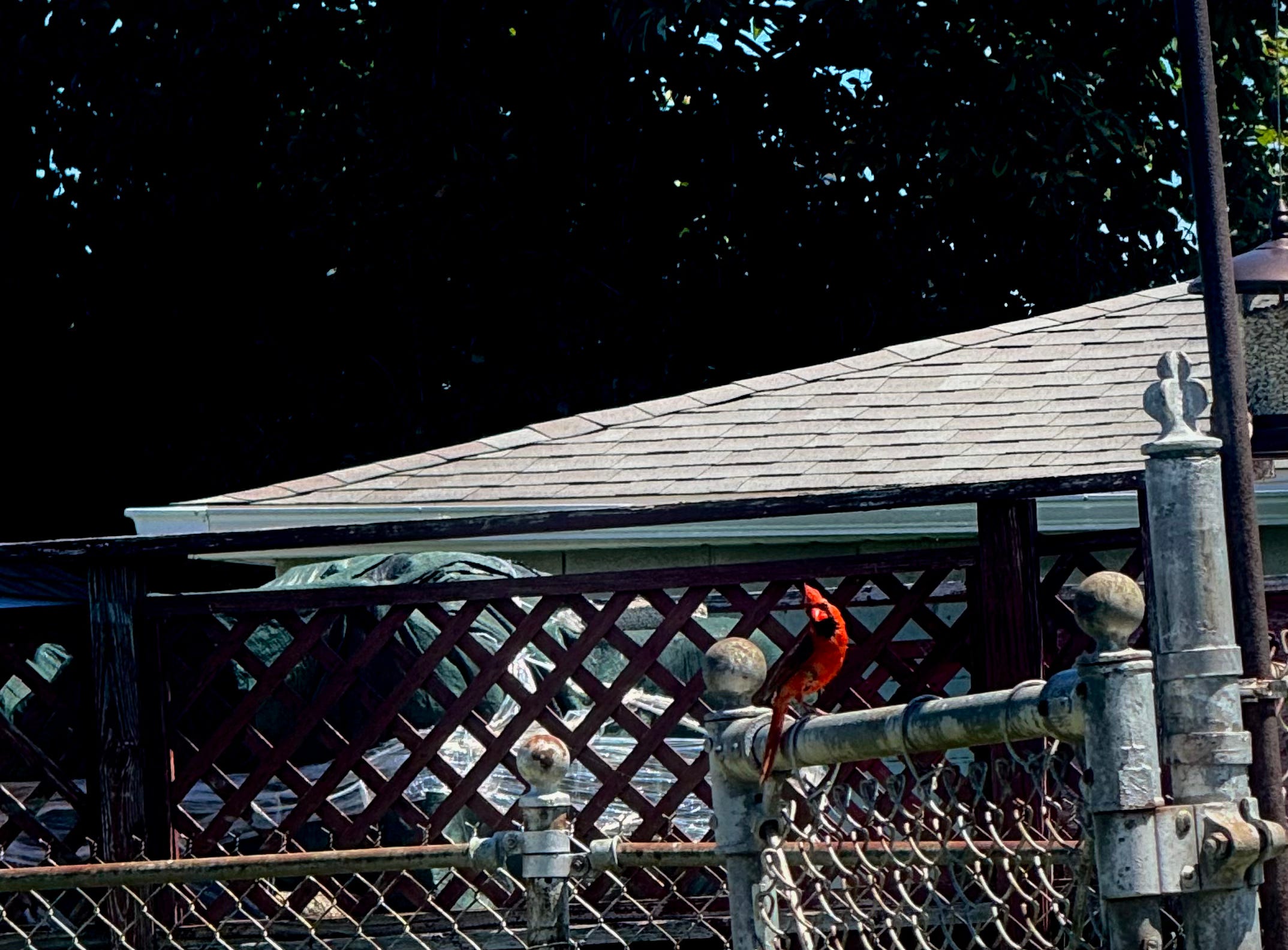
For a brief moment, the weight that had been pressed against my chest faded away. I wasn’t thinking about bills or deadlines. I wasn't being spoon-fed someone else's thoughts. I wasn't scrolling through a curated feed of outrage and promotional ads. I wasn't thinking in the way modern life often teaches us to think. I was simply noticing.
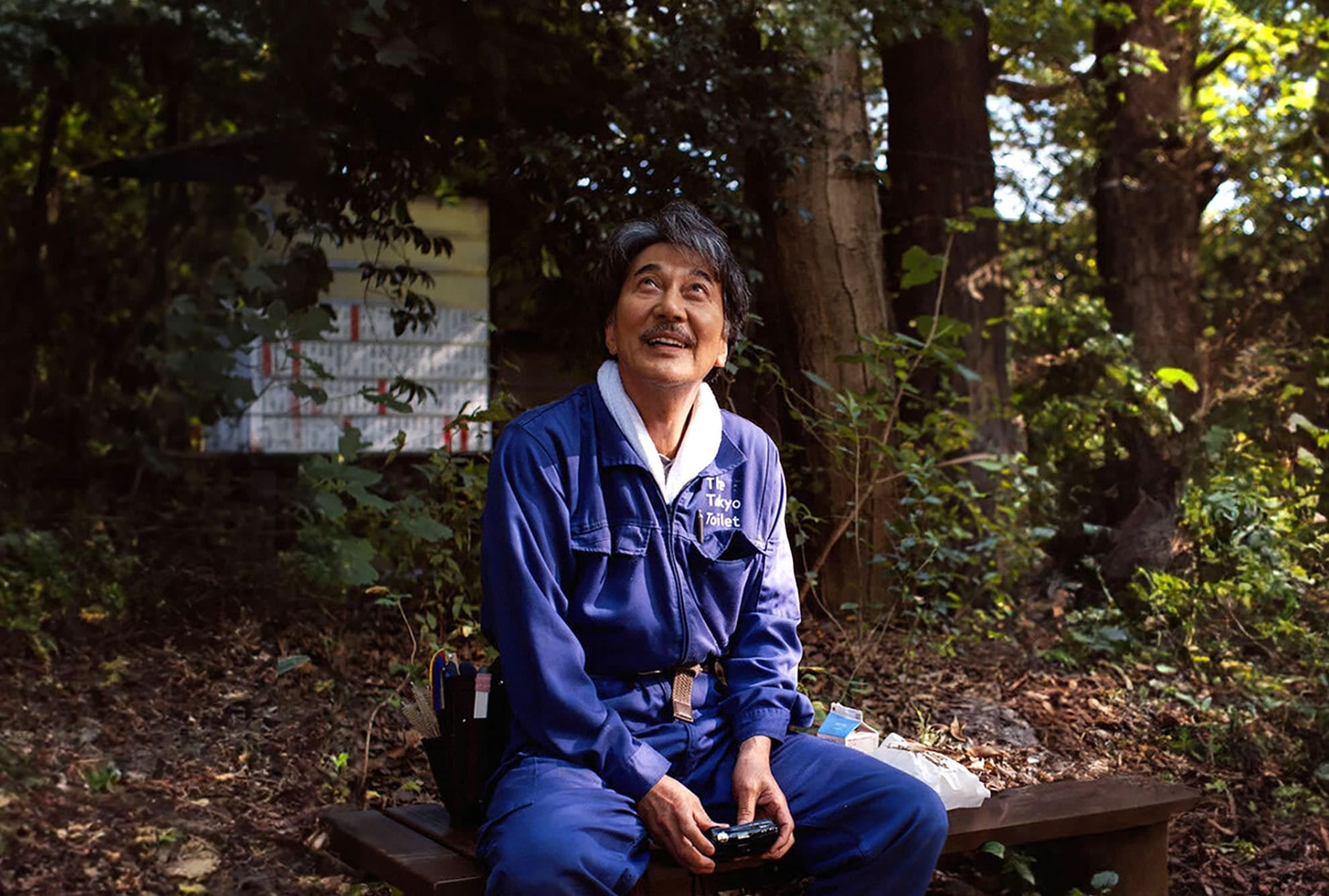
That's what I admired most about Perfect Days directed by Wim Wenders (one of my favorite films). On the surface, Wenders' main character, Hirayama, appears to live an uneventful life. Hirayama cleans public toilets, waters his plants, listens to cassette tapes, reads before bed, photographs the trees overhead. Nearly every day he abides by the same routine, except on his days off, when he rides his bicycle around Tokyo running personal errands. Nothing extraordinary happens — until you realize that's precisely the point. His life feels rich not because it is filled with spectacle, but because he refuses to overlook the ordinary.
Hirayama isn't content because he escaped work — he still works every day. He's content because he never stops looking up. He notices the play of sunlight through leaves, what the Japanese call komorebi. A fleeting pattern of light filtering through trees becomes a symbol for the kinds of moments that can't be captured by the internet. It is only available to someone who is present. Hirayama photographs the trees because the light is never exactly the same twice. He talks to new people who cross his path, reads different books, and listens to different music. Even in an ordinary life, we can find something new every day.
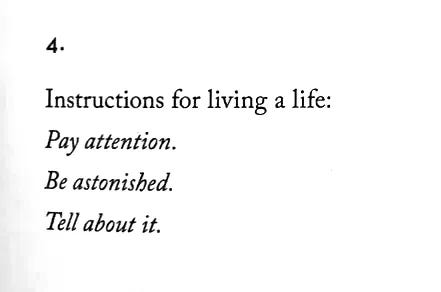
This way of seeing the world reminds me of Mary Oliver's simple instructions for living found in the poem “Sometimes” from her book Red Bird: "Pay attention. Be astonished. Tell about it." It sounds almost too simple, but again simplicity is the point. Attention is not passive. It is an act of participation. To pay attention is to tell the world that it is worth noticing.
The cardinal was not extraordinary because cardinals are rare. It was extraordinary because, for a brief moment, I was present enough to see it.
Living in a world so fast-paced, it feels almost rebellious to be idle — to simply exist. As I approach thirty years around the Sun near the end of August, I’m realizing that pausing leaves me with a profound sense of guilt that didn't exist when I was younger. I feel as though I’m wasting time that should be spent chasing my “dreams.”
Existing in a capitalist society that devours material dreams and spits them out into a “free” market has always left me thinking — if these dreams could be so easily taken away from me, then were they really ever dreams in the first place? Would my dreams even exist in a system that wasn’t oppressive? Or would I be enjoying the small moments like watching birds, instead of feeling guilty about unfinished projects or not spending my limited free time mastering my crafts.
Perhaps what I was searching for when I looked up and saw the cardinal was not an escape from my responsibilities, but a lesson that my worth does not exist solely in what I produce. A bird does not sing because it is trying to build a brand. A tree does not grow because it is trying to prove its productivity. Nature exists without needing to justify its existence.
Does a cardinal have any dreams? Do trees have any ambition? Do the stars ever worry they are not shining bright enough?
They just exist.
And while we cannot escape the complexity of the human experience — our dreams, anxieties, and desire for meaning — there is still something we can learn from the natural world. Maybe our dreams are not only waiting for some future moment when they become real. Maybe they exist every time we create, explore, and pay attention. There is no clock pressuring us to "materialize" our dreams, because they already exist in the act of creating them.
Being successful, gaining fame, receiving awards, getting a job promotion, these are all nice things. But they feed the human ego. Paying attention nourishes the soul.
I was so caught up in my phone that I almost missed the very moment I was waiting for.
The inspiration we’re searching for isn’t always found on a screen. Most of the time, it is waiting above us, asking only that we slow down, look up, and notice what has been there all along.

“It was extraordinary because, for a brief moment, I was present enough to see it.” Truly the most beautiful way to live…
I love the themes you pulled together for this one, the different directions tie together beautifully.
I wonder if this is how we, as people, felt before we had so many easy distractions? If the reason there’s entire cultures and beliefs that boil down to “the world is full of spirits”, where everything from the wind to the bird riding it were beautiful and fresh in our minds, is because we had the time to appreciate them.
What a beautiful essay, what a beautiful bird.
Thanks Sasha! I thought “komorebi” was interesting too. It’s so nice to know there’s a word to describe such a beautiful process of light filtering itself through trees. Something that only be noticed if we’re present enough.
I also appreciate you sharing that the cardinal reminds you of your grandmother. That’s really special. I think truly being one with nature is one of the most radical things one could do these days. People desperately need to get back into what makes them human.